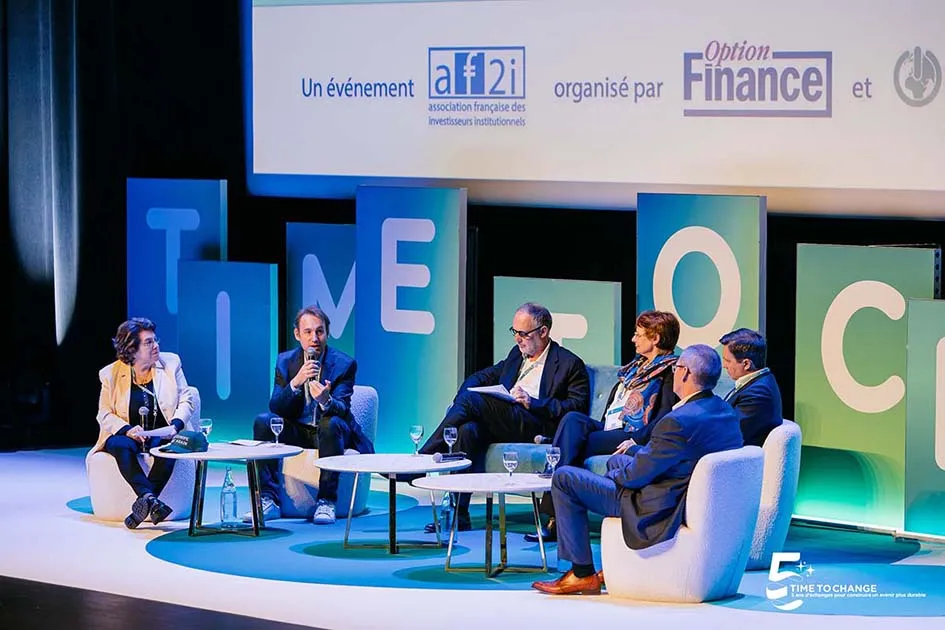
Business leaders, asset managers, scientists, representatives of civil society organisations and policy-makers gathered in Deauville on 26 and 27 March for the 2026 edition of Time to Change, an event dedicated to major climate-related issues. As every year, the WeeFin team was in attendance.
As this edition marked the event’s fifth anniversary, the organisers (the French Association of Institutional Investors, Option Finance and GreenUnivers) chose to address topical issues such as the role of defence and sovereignty, which featured alongside other topics such as the impact of regulation and the outlook for sustainable investment.
WeeFin’s co-founder and CEO, Grégoire Hug, was invited to speak at the plenary session dedicated to the challenges surrounding European competitiveness and sovereignty. This was an opportunity to reiterate that, when it comes to sustainable finance, Europe was in a leading position thanks to a more sophisticated regulatory framework which, far from being a hindrance to competitiveness, actually compelled global players (and in particular US asset managers) to play by the Old Continent’s rules or risk losing mandates (last year, US asset managers were thus deprived of more than €80 billion in mandates by European institutional investors, due to their insufficient commitment to sustainability).

Whilst Europe may seem like a small player compared to the US when it comes to sustainability data control (60% of the market is concentrated in the hands of three US players), this is by no means an insurmountable handicap for Europe. “Raw data has now become a commodity. What really matters is how we process it.However, European players still need to be given the means to grow, as scaling up for SMEs and start-ups is notoriously difficult in Europe, mainly due to financing issues. “Initiatives such as the 28th regime are, however, a step in the right direction. I am convinced that Europe has everything it needs to become a leader in the field of sustainable finance if we can harness our know-how, our ambition and our ability to take risks,” concludes Grégoire Hug.And in this regard, thanks to its rich ecosystem of impact fintechs, Europe in general and France in particular have a strong hand to play,” explained Grégoire Hug. Whilst Europeans may not be able to win the battle for LMMs against the American giants, they can nevertheless rely on specific applications of AI to foster leaders in specific areas. “That is the vision we champion at WeeFin. We have developed an AI agent dedicated to ESG analysis for sustainable finance, which draws on the context we provide – data and expertise – and enables considerable time savings. An analysis that previously took over 15 hours is now completed in a matter of minutes,” Grégoire Hug added.
However, European players still need to be given the means to grow, as scaling up for SMEs and start-ups is notoriously difficult in Europe, mainly due to financing issues. “Initiatives such as the 28th regime are, however, a step in the right direction. I am convinced that Europe has everything it needs to become a leader in the field of sustainable finance if we can harness our know-how, our ambition and our ability to take risks,” concludes Grégoire Hug.
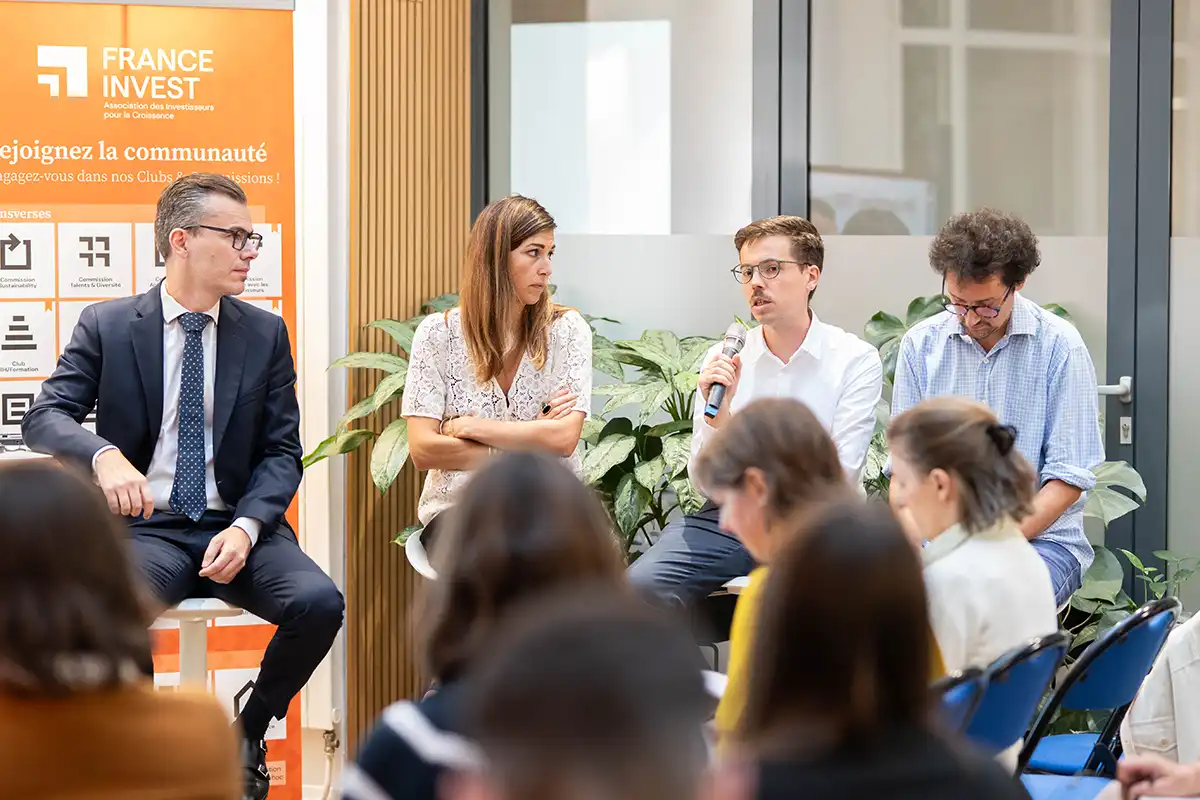
Discussions at this 2026 edition also addressed issues deeply rooted in the daily work of sustainable finance professionals, such as the management of data and ESG indicators. Laura Aich, Chief Operating Officer at WeeFin, took part in a roundtable dedicated to new metrics for measuring the impact of finance. The discussion quickly established that the challenge today is not to invent new indicators, but rather to know how to make use of the data that already exists. This obviously requires overcoming the challenges posed by the complexity, volume and heterogeneity of the data, “but that is the raison d’être of a platform like WeeFin, which aggregates and quality-assures sustainability data,” explained Laura Aich.

The use of technology also helps to address missing data by employing proxies for data that is harder to find or deemed less reliable, as is often the case, for example, with social issues. This will also be of great help in partially filling the gap created by the drastic reduction in the scope of the CSRD introduced this year, which will make it more difficult to collect data from companies, despite strong demand. And here again, AI will play a key role in speeding up and automating data processing.