

In sustainable finance, true differentiation doesn’t come from the data you buy, but from what you do with it. Yet, for most financial institutions, developing and testing proprietary methodologies remains a lengthy, technical and risky process. The Methodology Lab, a new service on the WeeFin platform, is a game-changer: it empowers ESG teams to design, test and validate their own scoring models, entirely independently, within a secure environment.
As regulatory requirements intensify and institutional clients expect increasingly differentiated approaches, ESG analysts and methodology experts often find themselves in a difficult position: they have the convictions, but not the tools to put them into practice.
Building a new scoring model (whether it involves adapting E/S/G weightings to a specific sector, simulating the impact of a change in data provider, or anticipating the consequences of regulatory changes such as SFDR 2.0) now requires mobilising technical teams, waiting for available slots, and working in an environment where every experiment risks contaminating production data. Not to mention that the traceability required by the regulatory framework is not always guaranteed.
The result: innovation cycles are lengthening, ideas remain on paper, and teams lose agility precisely where the market demands it most.
The Methodology Lab is a no-code sandbox environment, completely isolated from production data, in which ESG teams can build, test and validate their end-to-end scoring models without relying on a technical team.
Upon accessing the module, users immediately have a complete map of their existing models, represented as a dependency tree. At a glance, it is possible to see how the models interconnect (which building blocks feed into which scores, where gaps lie, and where improvements are possible). This clarity is particularly valuable in organisations where several teams contribute to the methodological framework.
Before defining the inputs for a new model, it is essential to know which indicators to use and which are actually available and relevant for a given investment universe. The Exploration view allows you to compare available data sources (MSCI, Sustainalytics, CDP, etc.), analyse their coverage rates by asset class and identify potential biases. This is a validation step that is often overlooked when done manually. Here, it is integrated directly into the workflow.
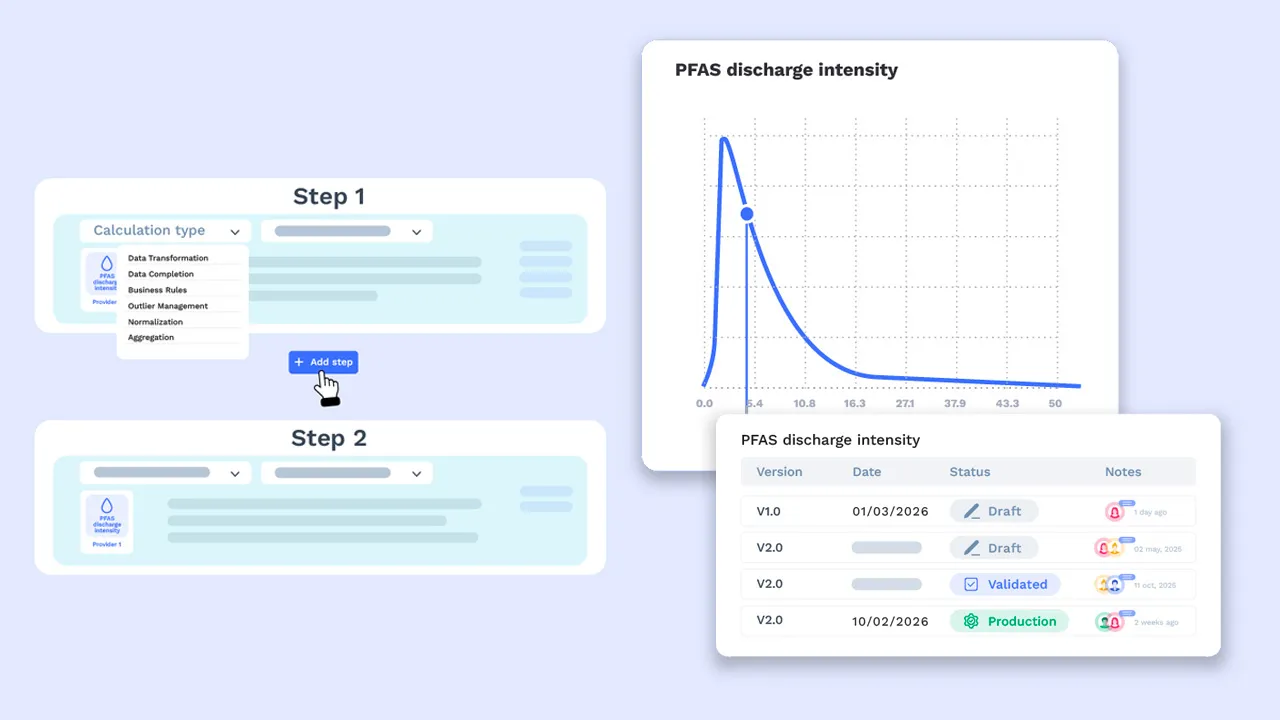
Once the inputs have been identified, the model is built by assembling calculation steps from a library of ready-to-use operators: weighted aggregation, normalisation, capping, etc. This collection has been developed based on use cases observed by the WeeFin team, whose expertise in supporting financial institutions with the development of their ESG methodologies is widely recognised.
Each step is configurable, results can be viewed in real time in the Analytics section, and successive iterations allow the model to be refined until one is obtained that exactly matches the team’s convictions.
It is also possible to start with an existing methodology and modify it (by adjusting weights, substituting sources or testing variants) without affecting models in production.
Every change is tracked. The Methodology Lab maintains a complete version history, including authors, dates, statuses (draft, validated, in production) and change notes. When a model is ready, it can be deployed to production directly from the module, or exported in a machine-readable format to be passed on to technical teams. This traceability directly meets the governance and auditability requirements imposed by regulators.
Designing and testing a new methodology no longer requires opening an IT ticket or waiting for technical availability. The sandbox environment ensures that experiments do not affect production data, freeing teams to iterate quickly and securely. An analyst can test several weighting variants in a matter of hours, where previously this would have required several weeks of coordination.
The Methodology Lab allows you to simulate the impact of a new methodology directly on real portfolios and funds, with score variations by entity, before-and-after comparisons, and a clear visualisation of the implications for portfolio composition. This is a decisive advantage for assessing the suitability of adopting a new approach before any actual deployment.
In a regulatory environment where every methodological decision must be justifiable, automatic versioning and the traceability of changes provide a direct operational advantage. Whether for an internal review or a regulatory audit, teams can produce comprehensive documentation of their models’ history without any extra effort.
Differentiation in sustainable finance increasingly hinges on the quality of proprietary methodologies. The Methodology Lab empowers financial institutions to build them with the rigour, speed and traceability that this ambition demands. A methodological innovation that remains on paper is not an innovation. With the Methodology Lab, it comes to life.
To find out more about the Methodology Lab, request a personalised demo with our team of sustainable finance experts.
