

Sustainable finance: choosing ESG management software
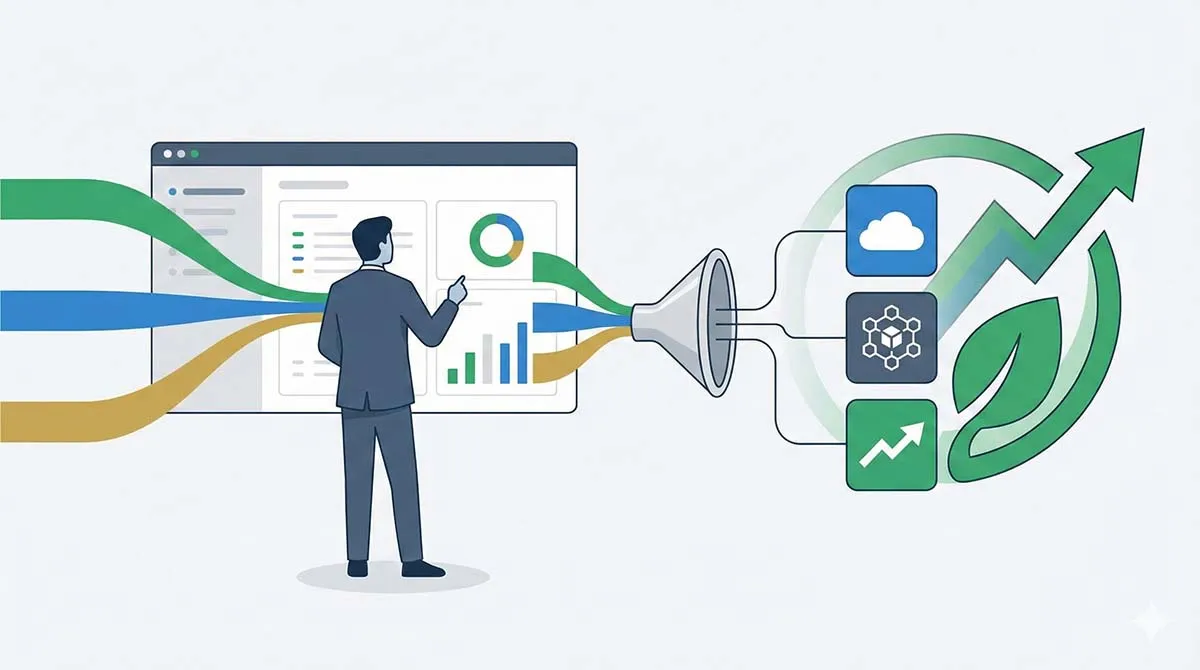

This software must be capable of collecting and aggregating data, analysing it using methodologies tailored to the needs of financial players, reporting, monitoring processes such as shareholder engagement, etc. Our analysis offers a structured methodological approach to guide you in selecting a solution tailored to your challenges.
Step 1: Define your needs
A good approach begins with an analysis of your operational constraints and regulatory compliance requirements. But it also requires as accurate an assessment as possible of your existing data flows.
Map data flows
An initial mapping of your data sources and flows will enable you to estimate their degree of complexity (often high in the case of an ESG approach) and guide you towards a well-dimensioned technological solution. This identification phase must also anticipate the development of your investment strategies, taking into account market aspirations.
Determine the maturity of the ESG data at your disposal
The audit of your existing data ecosystem directly determines the technological architecture to be adopted. This assessment focuses on the quality, completeness and frequency of updates of your current ESG data sources.
This audit phase often reveals significant gaps in coverage. A solution capable of aggregating heterogeneous data from multiple providers will therefore prove to be a valuable asset for financial institutions.
Choose your key features
A good ESG platform should have a modular architecture that allows you to pick and choose the features you need from a wide range. It is then up to you to decide, based on your organisation and market expectations, which modules you will equip yourself with: data management, monitoring, simulation, reporting, shareholder engagement management, etc.
Assess your regulatory constraints
The ESG regulatory environment is becoming increasingly complex, requiring constant monitoring. The SFDR regulations in the European Union, or SDR in the United Kingdom, impose enhanced transparency requirements. Other texts (CSRD, CS3D, Taxonomy, etc.) must also be integrated into your ESG software.
Anticipating regulatory changes is a real differentiating factor. The most effective technological solutions rely on proactive regulatory monitoring and rapid adaptation mechanisms to ensure compliance.
Step 2: Integration into your workflow
The effectiveness of an ESG platform also depends on its ability to integrate into your current technical architecture and communicate effectively with the other tools your teams use on a daily basis.
Data centralisation and processing
Centralising ESG data flows is a prerequisite for industrialising your information processing methods. The most effective technological solutions are capable of ensuring a complete data management process, so as to centralise all the necessary data, process it so that it is usable and can be used to calculate your ESG indicators.
Analysis and customisation of indicators
Your ESG platform must also allow for the development of customised composite indicators, integrating your proprietary methodologies and specific investment constraints. Interoperability with your existing tools optimises the efficiency of your workflows and reduces friction.
Step 3: Analysis of results and ESG performance management
ESG performance management requires an analytical approach that integrates quantitative and qualitative dimensions. Your software must provide a holistic view of your investments, combining portfolio analysis and ESG risk monitoring.
The forward-looking dimension of management incorporates predictive models that anticipate the impact of potential changes on the ESG performance of your portfolios. The ability to track certain actions that can be implemented to improve this performance (such as exclusion management or shareholder engagement) is obviously a valuable addition to such platforms.
Step 4: Creation of regulatory reporting
Automating regulatory reporting generates substantial efficiency gains while reducing the risk of non-compliance. Leading technological solutions incorporate pre-configured templates (e.g. for SFDR or CSRD) that comply with the main regulatory frameworks.
Why choose WeeFin to manage your ESG objectives?
WeeFin combines analytical excellence with ease of use. Our platform natively integrates compliance with current regulations (and the ability to adapt to any future changes in this framework) while offering maximum flexibility to adapt to your proprietary processes.
Our collaborative approach focuses on supporting our clients in their ESG digital transformation. This is provided by our team of sustainable finance experts. An ‘expertise hub’ is also available to WeeFin customers. It contains numerous resources to help them master all aspects of sustainable finance.
WeeFin's modular architecture is also a valuable advantage in an ever-changing environment. It can be adapted to the specific operational requirements of each institution, thereby optimising the efficiency of existing workflows. Specialised modules (data management, shareholder engagement, monitoring and analysis, reporting, etc.) integrate seamlessly into your organisation.
FAQ: Choosing your ESG software
What are the main challenges associated with collecting sustainability-related data?
ESG data collection presents structural challenges due to the heterogeneity of sources and methodologies. The main obstacles include limited standardisation of information and reporting frameworks, uneven coverage by data providers, etc.
The qualitative nature of many ESG criteria makes them difficult to quantify and compare. Methodological biases also lead to differences in assessment, requiring tools capable of performing sophisticated reconciliation processes.
How can ESG software help you invest intelligently?
An ESG platform optimises the efficiency of your investment processes by automating low-value-added tasks and freeing up time for strategic analysis. Proactive identification of emerging ESG risks allows you to anticipate market corrections and optimise investment timing. This approach to ESG investing is a major competitive differentiator.
How important is interoperability with existing systems?
Technical interoperability is a key success factor in the adoption of a sustainability management solution. Seamless integration with your existing tool ecosystem and data sources directly determines operational efficiency and user adoption. A modular architecture facilitates the scalability of your organisation, allowing for the gradual integration of new features without disrupting existing processes. This technical approach ensures the longevity of your technology investment in a rapidly changing sector.
How can you assess the cost-effectiveness of ESG software for your organisation?
Assessing the cost-effectiveness of such a system over time requires putting productivity gains, reduced compliance risks and optimised investment performance into perspective. Indirect benefits include accelerated time-to-market for new ESG products, improved customer satisfaction through enhanced transparency, and competitive differentiation in the sustainable finance segment.
